The Peacetime Service Myth: How the VA Fails Veterans of an Era That Was Never Peaceful
I understand Veteran's frustrations—and frankly, the data supports it. The gap between what actually happened during 1976–1989 and how the Department of Veterans Affairs classifies that service is not just misleading; it's systematically harmful to the veterans who lived through it.
The Numbers Don't Lie, But the VA's Labels Do
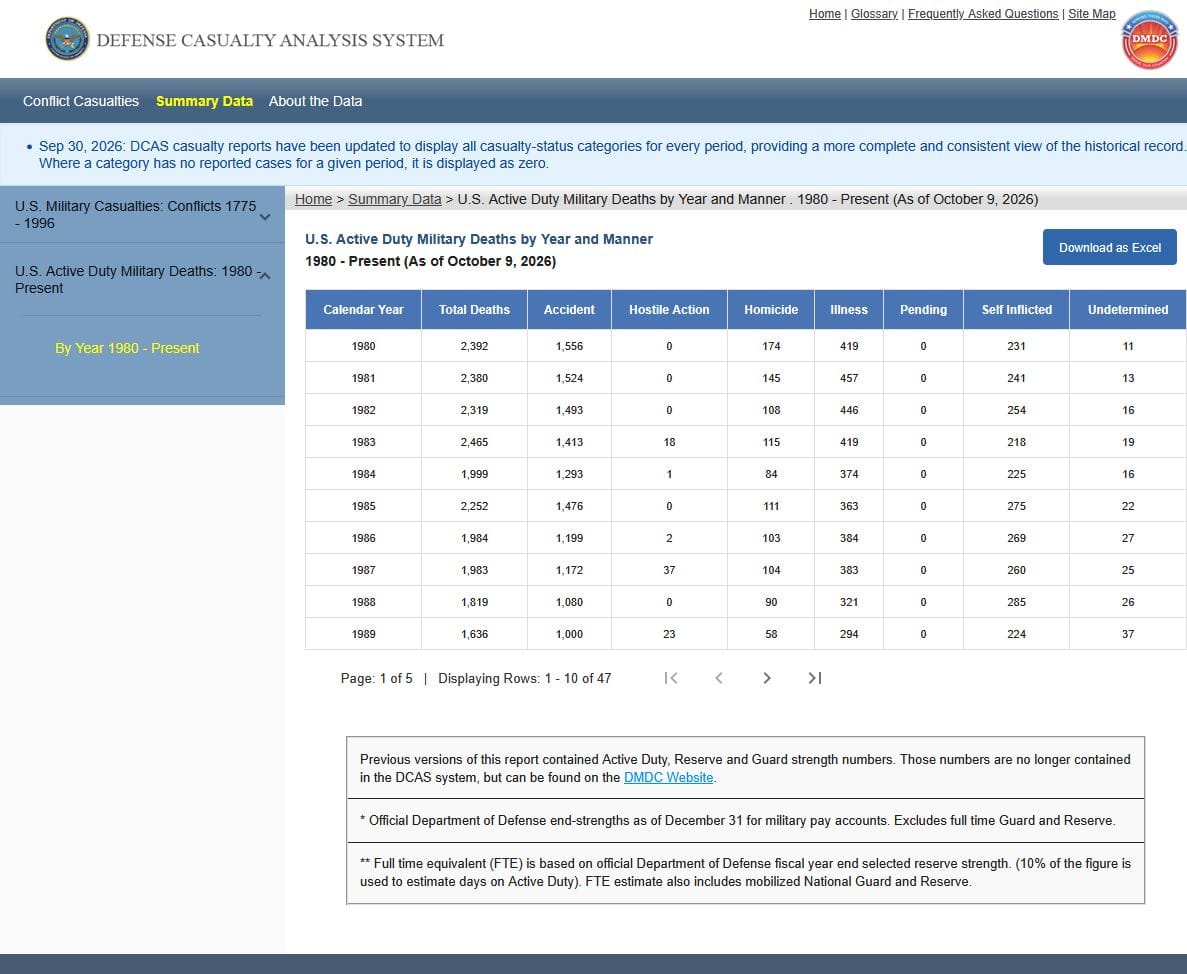
Between 1976 and 1989, approximately 40,000 U.S. service members died while serving their country. The majority weren't lost to accidents alone—they were killed in hostile actions, peacekeeping missions, and military operations across the globe. Yet the VA insists on labeling this entire 13-year period as "peacetime service."
This isn't a semantic quirk. It's a classification system designed to create a two-tiered veteran population, with 1976–1989 service members relegated to "second-class" status, making it significantly easier for the Veterans Benefits Administration (VBA) to deny them earned compensation.
The evidence is staggering:
- October 23, 1983: Beirut Barracks Bombing — 241 U.S. service members (220 Marines, 18 sailors, 3 soldiers) were killed in a single truck bomb attack. Yet the VA recorded only 18 service members killed in "hostile action" for all of 1983.
- May 17, 1987: USS Stark Attack — Iraqi Exocet missiles killed 37 sailors. Iraq claimed it was a mistake, but it was still an attack by a hostile force on an American military vessel.
- Operation Earnest Will and Operation Praying Mantis — Active combat operations in the Persian Gulf protecting shipping lanes and engaging Iranian naval assets.
- Operation Urgent Fury (Grenada, 1983) — An invasion operation resulting in military deaths.
- Operation Just Cause (Panama, 1989) — Another military operation resulting in servicemember fatalities.
The Logical Absurdity
The VA's position requires us to accept a truly asinine premise: that 241 Marines weren't killed by hostile action in Beirut; that servicemembers deployed to the Persian Gulf during active naval engagements faced no hostile threat; that military training accidents are the only significant cause of death during a period marked by multiple combat operations.
According to the VA's framework, veterans who served during this era were exposed to nothing more than "puppy dogs, unicorns, and rainbows." No toxins. No chemicals. No biological or radiological hazards. Nothing that could possibly injure a service member in any meaningful way.
This isn't just wrong—it's deliberately constructed to be wrong, because classifying these years as "peacetime" allows the VBA to apply a lower standard of proof when denying compensation claims.
Why This Matters Today
Veterans who served 1976–1989 face an uphill battle proving service-connected disabilities. Want to claim exposure to Agent Orange? The VA will point out you served during "peacetime"—never mind that you were in the Persian Gulf or deployed to multiple conflict zones. Suffering from conditions consistent with biological or chemical exposure? "Peacetime service" becomes the convenient cudgel to deny your claim.
The burden of proof shifts entirely onto the veteran, who must now overcome not just the standard evidentiary requirements but also the VA's preferred narrative that nothing dangerous happened during those 13 years.
The Path Forward
This system is indefensible on the facts. The data presented above proves it. What's needed is recognition that service between 1976 and 1989 was not peacetime—it was a period of sustained military operations, hostile engagements, and significant loss of life. Reclassifying this era appropriately would acknowledge the truth and remove one of the VA's most effective tools for denying veterans their earned benefits.
A Veteran's frustration is justified. The veterans of this period sacrificed just as much as those who served in recognized conflict zones. They deserve the same dignity, the same presumption of service-connection, and the same benefits their sacrifice earned them.